overview
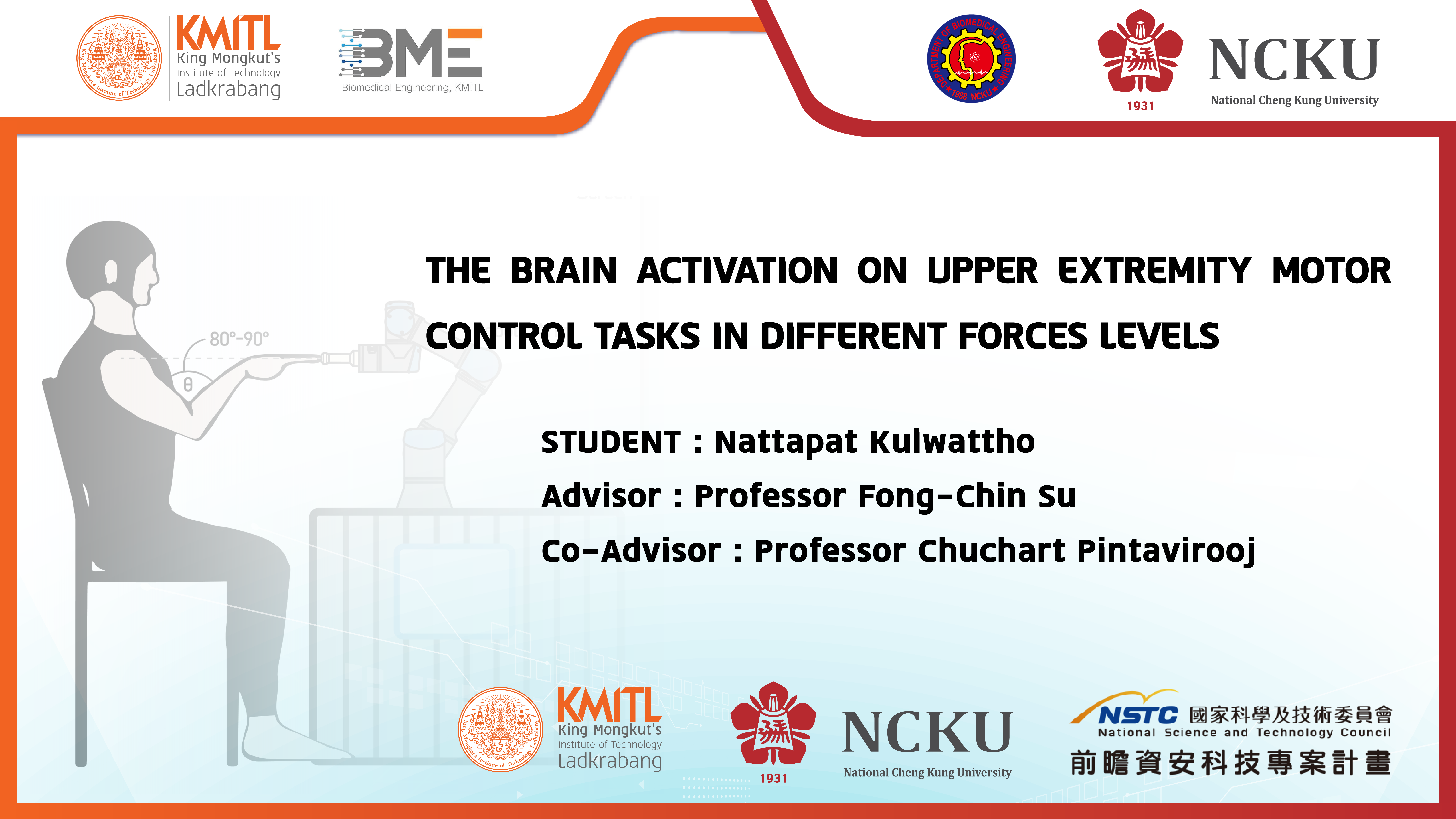
Started as a research project during my overseas study at National Cheng Kung University (NCKU), Taiwan, during July, 2024 to November, 2024, this study explored brain activation during upper-extremity force regulation at everyday-relevant force levels (4, 12, 20 N), under static and dynamic tasks. Eighteen healthy adults performed the tasks while fNIRS recorded HbO/HbR over PFC, PMC, SMA, and M1.
My Contributions
I led the research project from conception to completion, designing the methodology, conducting experiments, and performing comprehensive data processing and statistical analysis. In addition to analyzing the results and facilitating the discussion, I authored the full manuscript and created the accompanying illustrations.
Methods
- Participants: 18 young adults (5 male, 13 female; mean 22.33 ± 1.80 y)
- Experiment & conditions: 3 difficulty levels (Easy 4 N / Moderate 12 N/ Hard 20 N ) and 2 movements (static, dynamic)
- Robotic arm as force regulator: UR3e regulated force and guided motion
- fNIRS: NIRx NIRScout (8 LED sources and 16 detectors, 30 channels at 760/850 nm; 7.81 Hz) over PFC, PMC, SMA, M1 according to EEG1010 montage.
- Processing: Homer3 pipeline and AtlasViewer for topomaps.
- Statistical Analysis: Two-way repeated-measures ANOVA (Task difficulty × Movement) with ART where non-normal with Bonferroni correction, and hemisphere tests (c vs i).
Key Results
- No interaction between difficulty and movement in any ROI.
- Difficulty main effects: cM1, cPMC, iPMC, and iPFC show significant HbO increases with higher force demand; pairwise effects strongest easy to hard.
- Movement main effect: PFC only; static > dynamic in both hemispheres.
- Hemisphere effects: M1 shows contralateral have higher activity than ipsilateral; PFC shows ipsilateral less negative than contralateral.